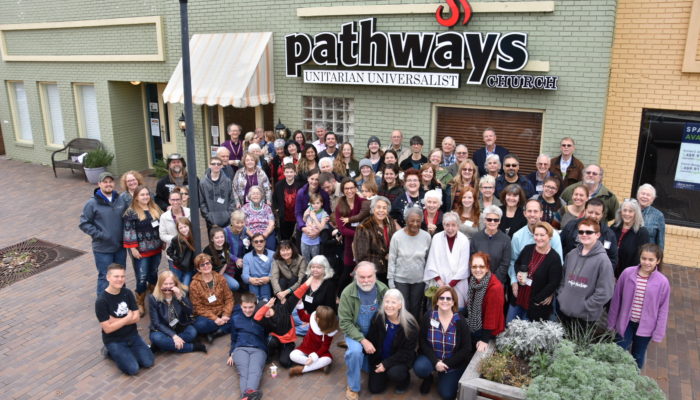
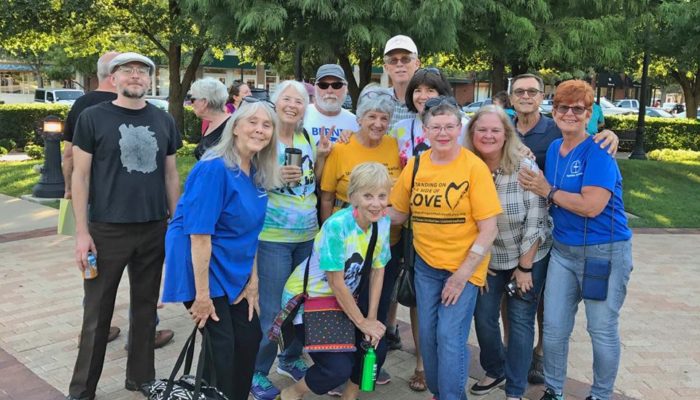
Welcome to Pathways! We are a diverse group of people working together to build a spiritual community that changes lives.
We're on a mission to create the change we wish to see in the world. We engage in hope, healing and heresy. We understand that the word heresy comes from the ancient Greek word "hereomai" meaning "choice." In our creedless practice of liberal religion we do not give up the right to choose what we think and believe. Join us.
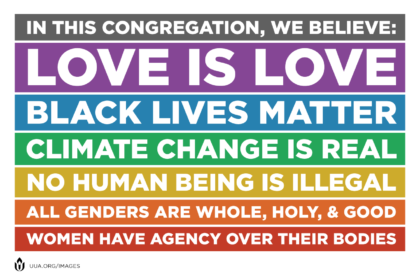
You are welcome at Pathways Church regardless of race, gender, sexual orientation, income, or ability. Here we welcome all colors of the human race, all people of good will, whether you are Jewish, Christian, Buddhist, Muslim, Hindu, Pagan, Mystic, Atheist, Agnostic or Humanist; young or old; single or partnered; gay, lesbian, bisexual, or straight; transgender, intersex, male or female; disabled or temporarily abled. Here, we know you bring your own unique gifts to this community.
Here you are welcome. Come as you are.
We are affiliated with the more than 1000 other congregations that make up the Unitarian Universalist Association. The Unitarian Universalist Association was born in 1961 with the consolidation of the American Unitarian Association and the Universalist Church of America. Unitarianism traces its roots to the Anti-Trinitarians of the early Christian church who believed God was a unity, a single entity and Jesus, a messenger of God, was human. The Universalists believed that God saved everyone; that a loving God condemns no one to eternal damnation. This idea goes all the way back to "church fathers" such as Origen and Clement of Alexandria.
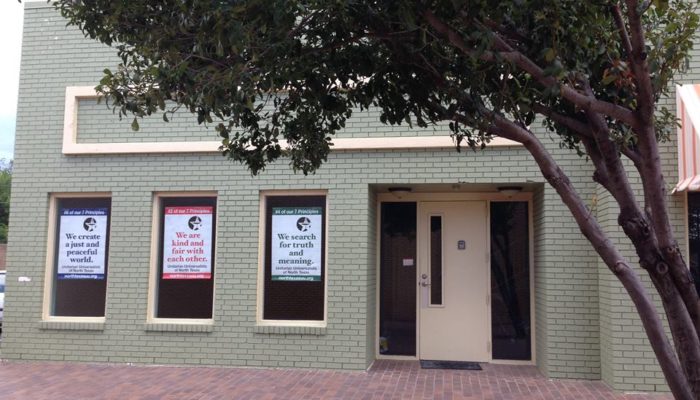
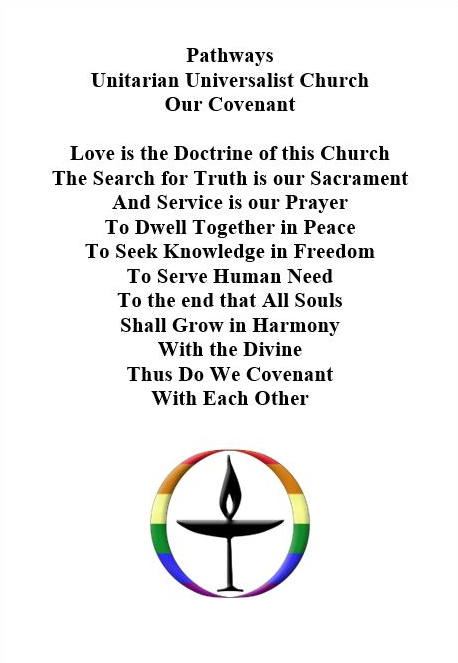
Today Unitarian Universalists put religious insights to the tests of heart and mind. We are not bound by dogma. We maintain revelation is not closed and continue the search for truth and meaning. We call Unitarian Universalism a Living Tradition. We believe in social justice, equality, democracy, and compassion, and that how a person lives is more important than what a person says they believe. Our churches are held together by covenants, like our Pathways DNA, not by creedal tests or formals. How we agree to be together is more important than ideas we must all hold in common about ultimate truth. In the end, religious authority lies not in a person, not in a book, not in a creed, but in ourselves.